User Survey Report on the Cognitive and Emotional Effects of Sudoku
Our team develops the online portal Sudoku-Guru.com and mobile apps for playing Sudoku, and we have repeatedly encountered the following question from users: “Does Sudoku improve brain function?” In other words, is there a real effect on memory, attention, and other components of our thinking?
You may think that the entire gameplay process comes down to filling cells with numbers according to given rules. But behind this facade lies the work of your attention, logic, and a chain of cognitive processes.
The process of solving Sudoku includes:
- Holding several options in mind at once (working memory training);
- Building logical chains (logic development);
- Switching between strategies (cognitive flexibility);
- Concentrating on details (attention training).
All of this is supported by an optical tomography study, where Sudoku is associated with the engagement of the prefrontal cortex. This is the area actively involved in executive functions such as planning and decision-making.
Based on scientific data, Sudoku can be used for an intellectual warm-up before a complex task, for improving concentration, or for developing analytical abilities.
So, initially, in order to answer the question “Does Sudoku improve brain function?”, we wanted to take the scientific evidence, available studies, and write an article on the topic. But we quickly ran into the fact that researchers’ conclusions often depend on the methodology, the sample, and how exactly the effect was measured. That is why we decided to conduct our own user survey and prepare a study with conclusions based on it.
In addition, we have a major advantage on our side — a base of approximately 200,000 real players, some of whom interact with the app daily.
We managed to conduct a survey among 9,470 players of the Sudoku-Guru.com website and our mobile apps to find out whether they feel a positive impact of the game on cognitive functions.
Brief survey results of Sudoku-Guru.com players:
Concentration and focus:
- 52% said that after playing Sudoku, their concentration improved
- 48% noted that task switching became better
Logic and planning:
- 44% of players noted that the speed of mental operations increased
- 47% noted positive changes in planning.
Sudoku really does require planning and control of game strategy (especially difficult and guru levels). This is supported by scientific papers, where Sudoku is used as a task with high cognitive engagement related to planning.
Memory:
Some users noted subjective changes in everyday life:
- 45% noted that their memory in daily activities improved;
- 48% noticed no improvements.
Emotional effect and reduced anxiety
- 3.7 (out of 5) — the average score from users who use Sudoku as an anti-stress activity or a break to distract themselves
Based on the data obtained, we can say:
- For many people, Sudoku is perceived as a way to “warm up the brain,” but for about half of them this is not felt as a transferable skill;
- Players more often associate Sudoku with logic and planning than, for example, with memory. This is logical: Sudoku trains strategy, hypothesis testing, and keeping constraints in mind — that is, what people subjectively describe as “logic.”
- The effect on memory is perceived ambiguously: about half notice it, half do not
- Sudoku is perceived as a moderately effective “break/anti-stress” tool rather than a strong means of reducing anxiety. This is good for positioning: “switch off and calm down” — yes; “treats anxiety” — no.
Study design
The study consists of 3 blocks of questions:
- Block 1 (before playing): N = 9,470 unique users
- Block 2 (after a game session): N = 4,180 unique users responded
- Block 3 (after 10 game sessions): N = 1,180 (fewer responses due to churn)
First block.
Contains basic questions (necessary to understand the initial context and to exclude answers matching users’ expectations):
- Age: under 18 / 18–24 / 25–34 / 35–44 / 45–54 / 55–64 / 65+
- How long have you been solving Sudoku? (had not solved before / < 3 months / 3–12 months / 1–3 years / 3+ years)
- How often do you usually solve Sudoku? (less than once a week / 1–2 times/week / 3–5 times/week / almost every day / several times a day)
- Why do you solve Sudoku?
- to relax / relieve stress
- to train the brain / memory / attention
- to pass the time
- habit / ritual
- competitive interest (speed / records)
- other
- How much do you expect that regularly solving Sudoku will improve your cognitive abilities? (Scale from 1 to 5)
- What other “mental workouts” do you do regularly?
- crosswords / scanwords
- chess
- logic tasks / math puzzles
- brain training apps
- learning a language / music
- I do not do any
Second block.
Contains questions after a game session. It is needed to capture the state after playing and then compare it with the observed indicators of load and stress. This makes it possible to track how sensations and reactions change as experience accumulates.
Assessment of subjective cognitive load
(Scale from 1 to 5)
- How mentally demanding was this puzzle?
- How much mental effort did you put into solving it?
- How much time pressure / rush did you feel?
- How satisfied are you with how you performed?
- How much irritation did this task cause?
Stress and well-being
(Scale from 1 to 5)
- During solving, I felt stress / tension
- After solving, I feel calmer than before it
Engagement and focus of attention
(Scale from 1 to 5)
- I was fully immersed in the task
- I was often distracted by outside things
- I was bored
Third block.
Assessment of the impact on cognitive functions. A survey of players with 10 or more game sessions. Changes were recorded relative to a neutral scale, either for the worse or for the better.
Self-assessment of cognitive changes
(Scale from -3 to +3)
- Ability to concentrate on a task: (-3 … +3)
- Ability to notice errors / inconsistencies faster: (-3 … +3)
- Working memory (holding 2–3 “options” in mind simultaneously): (-3 … +3)
- Cognitive flexibility (switching between strategies if stuck): (-3 … +3)
- Planning steps ahead: (-3 … +3)
- Speed of “mental operations” (I calculate / compare / derive patterns faster): (-3 … +3)
Data obtained
Block 1. Before the first game session
Age of study participants
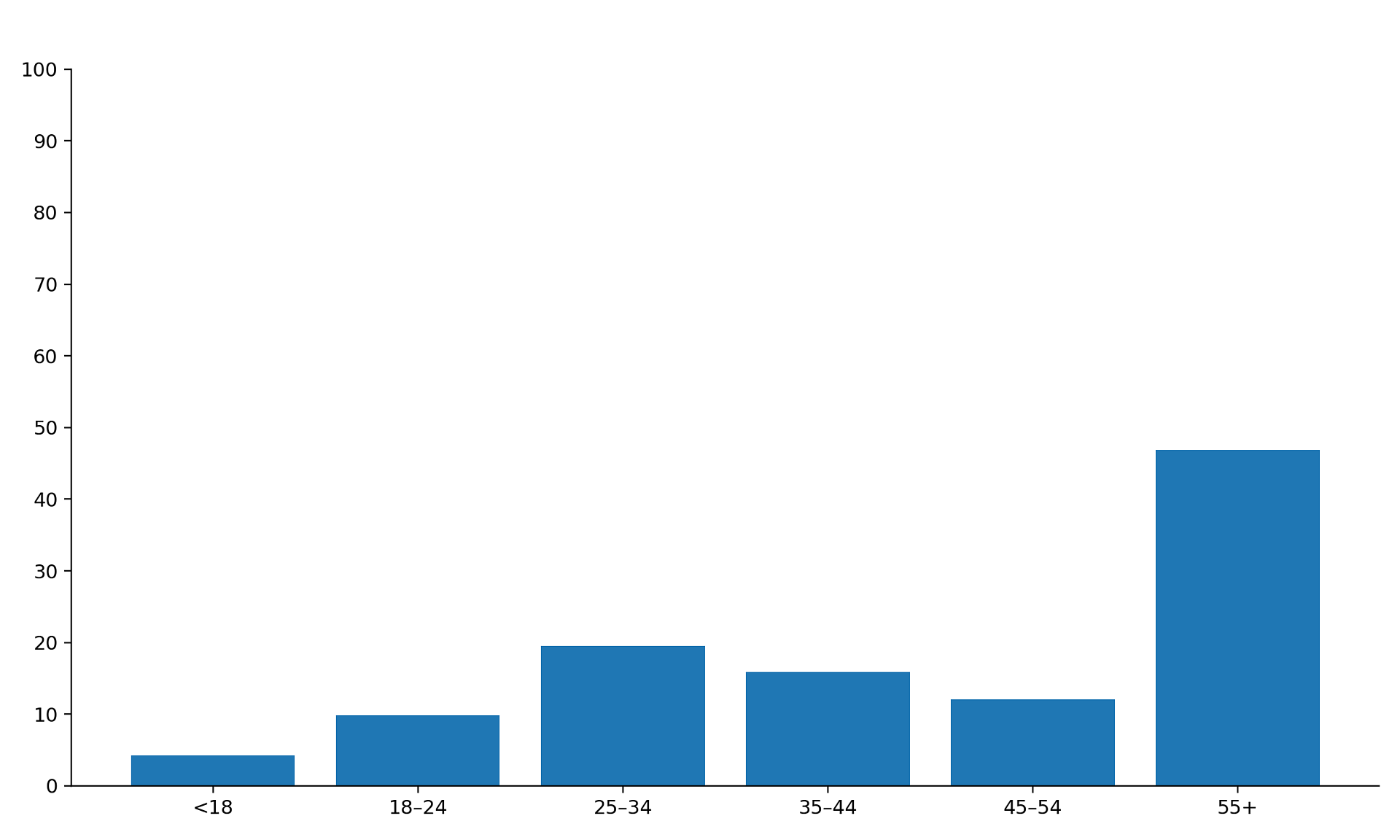
| Age | Share |
|---|---|
| under 18 | 4,27% |
| 18–24 | 9,83% |
| 25–34 | 19,49% |
| 35–44 | 15,88% |
| 45–54 | 12,03% |
| 55 and older | 46,84% |
Distribution by game experience in % (N=9470)
- A - Had not solved before
- B - < 3 months
- C - 3-12 months
- D - 1-3 years
- E - 3+ years
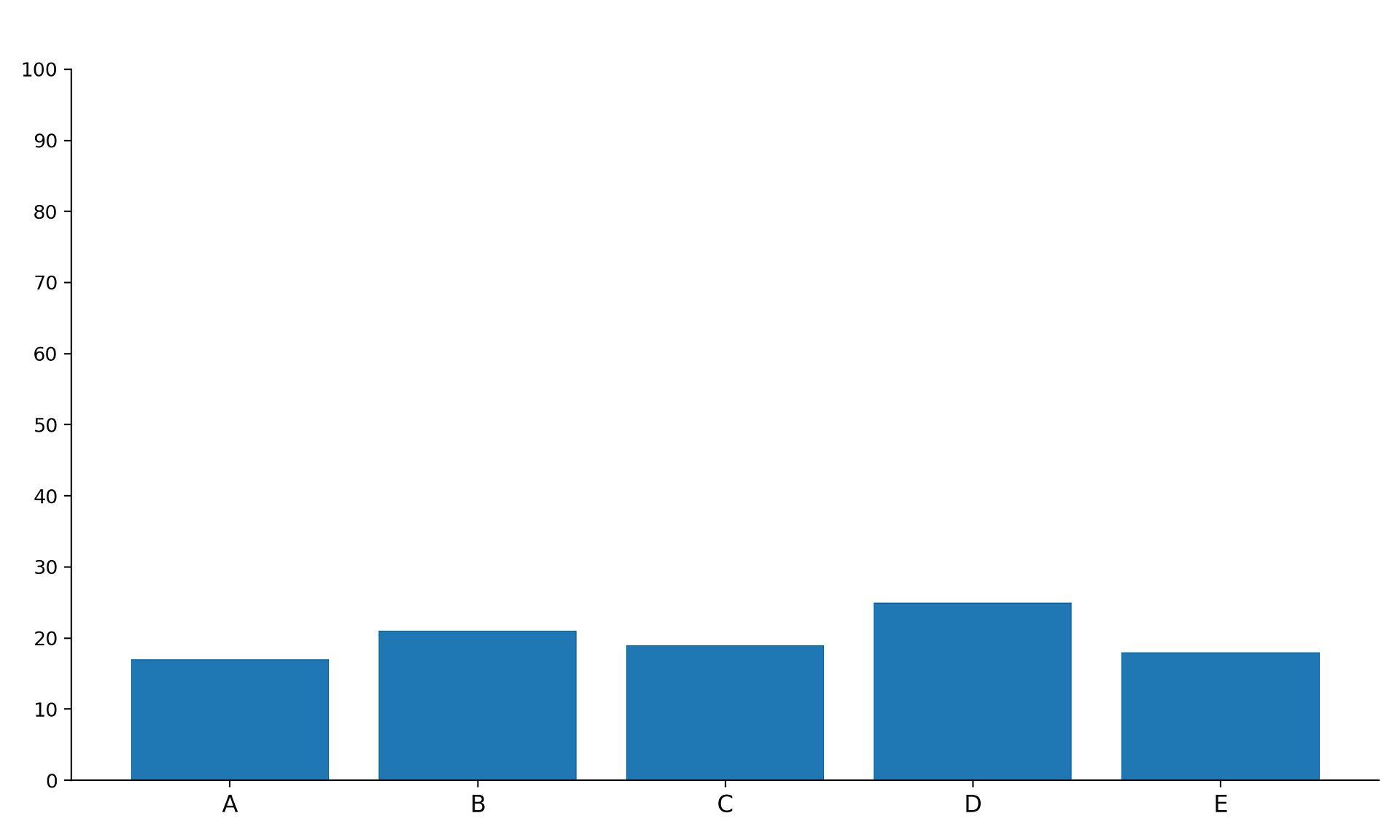
| Experience | Share |
|---|---|
| had not solved before | 17% |
| < 3 months | 21% |
| 3–12 months | 19% |
| 1–3 years | 25% |
| 3+ years | 18% |
Distribution by play frequency in % (N=9470)
- A - < 1 time per week
- B - 1-2 times per week
- C - 3-5 times per week
- D - Every day
- E - Several times a day
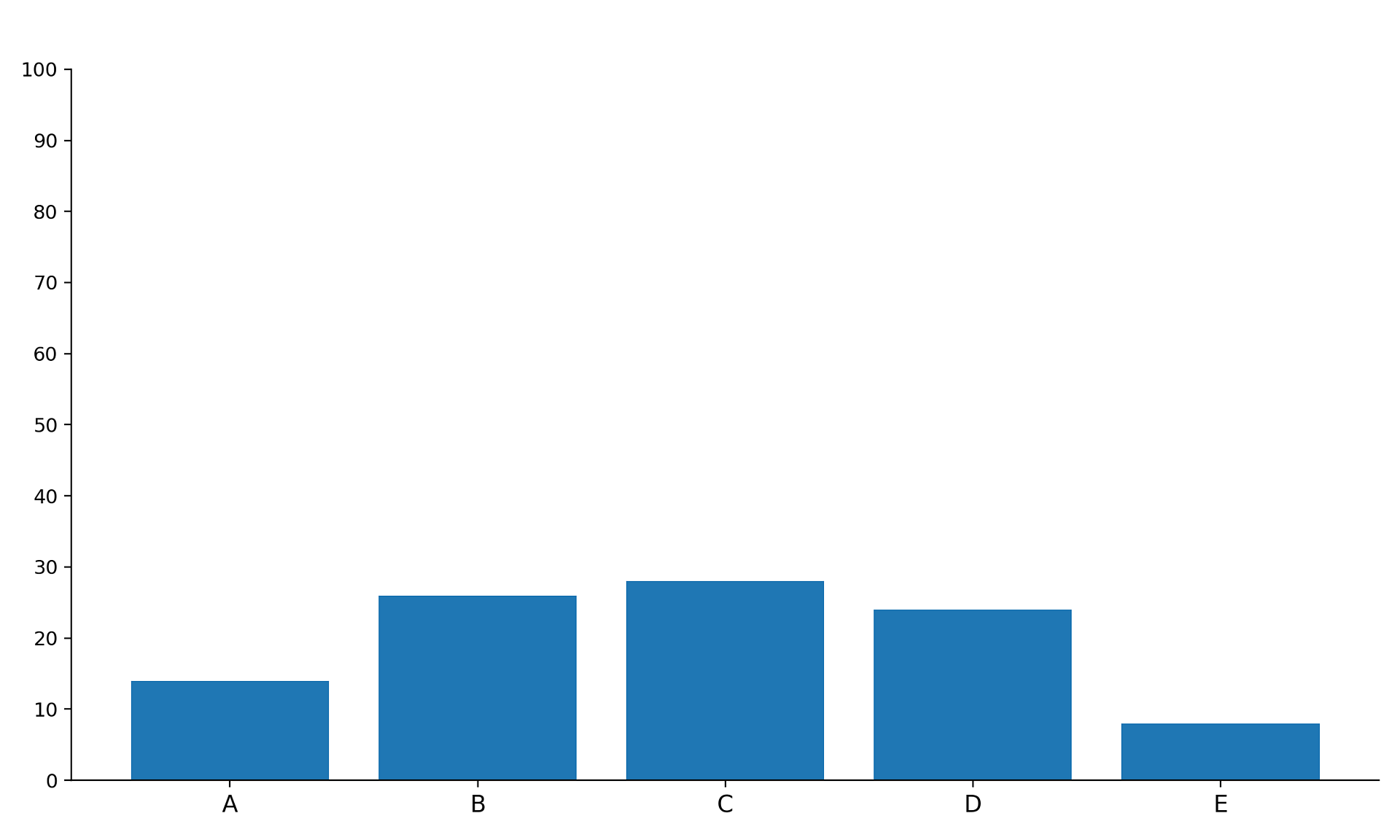
| Play frequency | Share |
|---|---|
| less than once/week | 14% |
| 1–2 times/week | 26% |
| 3–5 times/week | 28% |
| almost every day | 24% |
| several times a day | 8% |
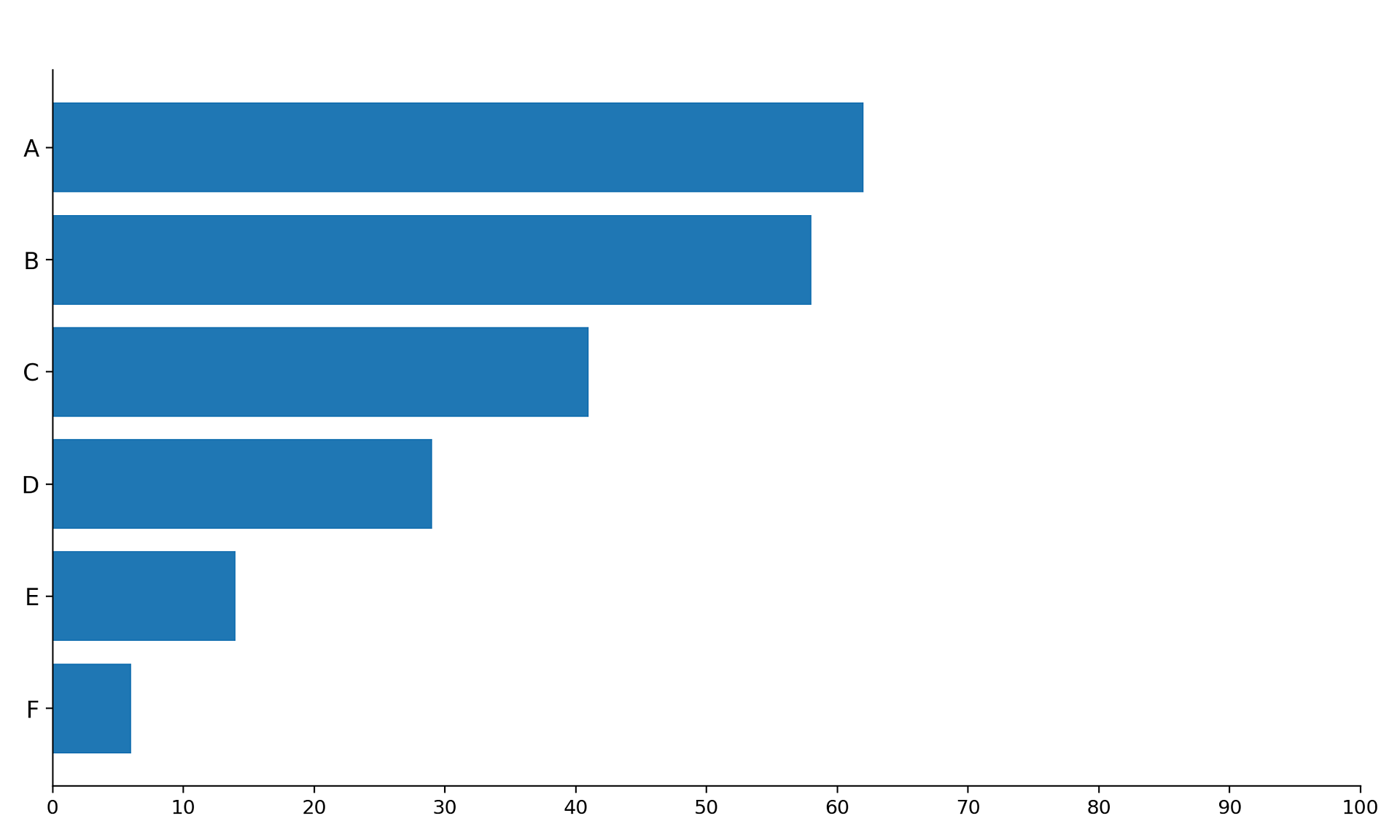
Why do you solve Sudoku?
- to relax / relieve stress — 62%
- to train the brain / memory / attention — 58%
- to pass the time — 41%
- habit / ritual — 29%
- competitive interest — 14%
- other — 6% (most often: “while traveling,” “instead of social media,” “to fall asleep”)
Distribution by purpose of play in % (N=9470)
- A - Relax / relieve stress
- B - Train the brain / memory / attention
- C - Pass the time
- D - Habit / ritual
- E - Competitive interest
- F - Other
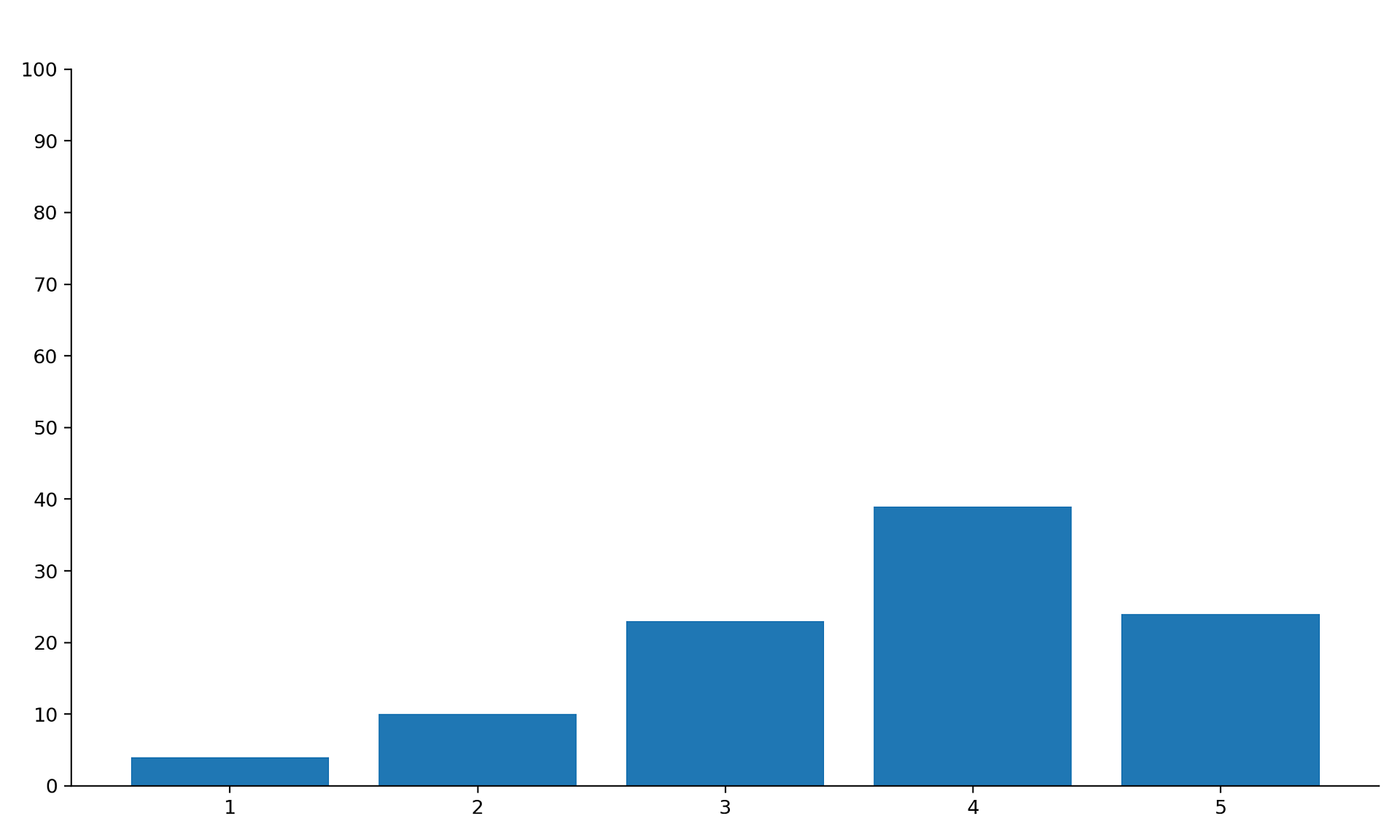
Expectation of cognitive improvement (1–5)
- Average 3.9, median 4
- Distribution: 1 — 4%, 2 — 10%, 3 — 23%, 4 — 39%, 5 — 24%.
Expectation of cognitive improvement, score distribution 1-5 in % (N=9470)
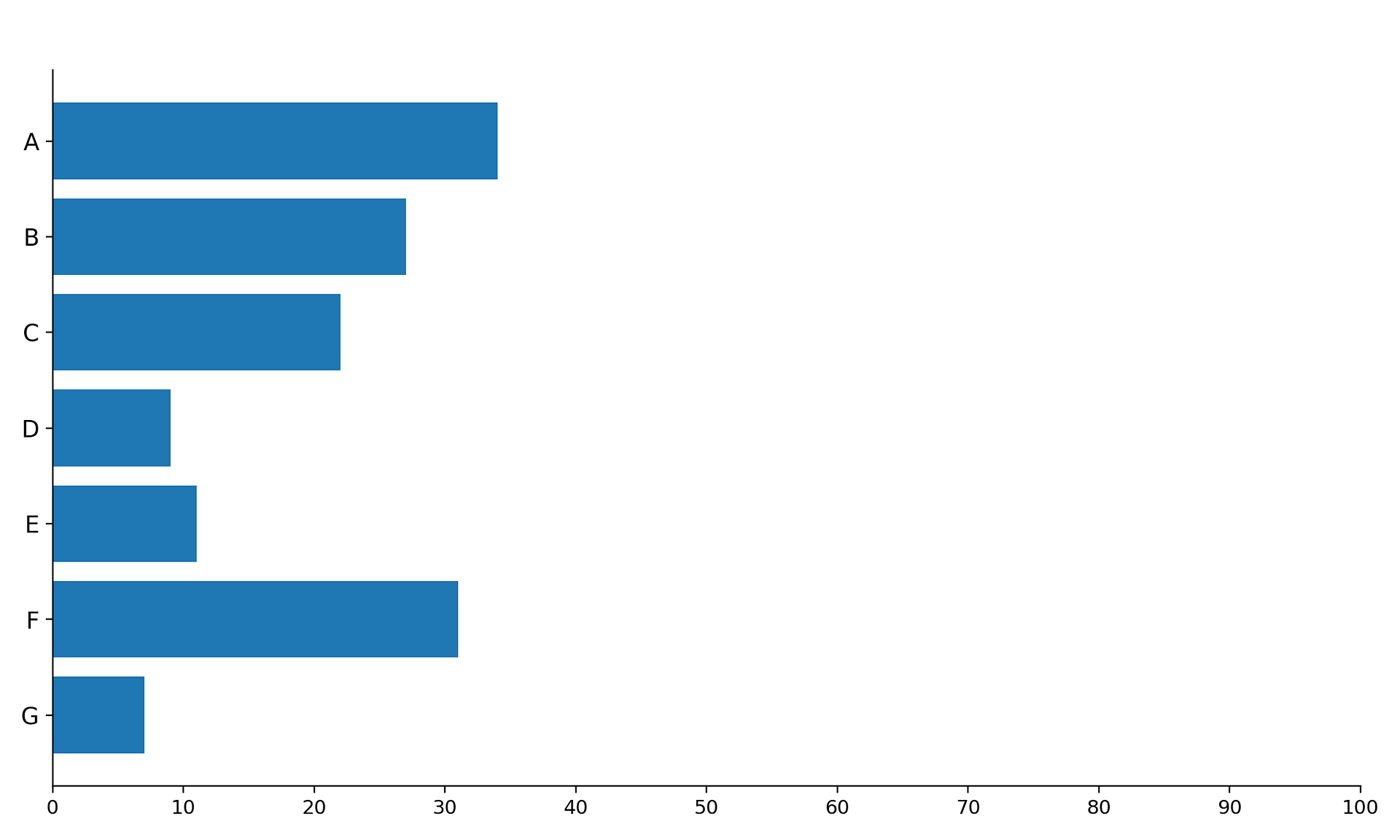
Other “mental workouts” (multiple choice)
Use of other mental workouts
- A - Crosswords / scanwords - 34%
- B - Logic tasks / math puzzles - 27%
- C - Learning a language / music - 22%
- D - Chess - 9%
- E - “brain training” apps - 11%
- F - I do not do any — 31%
- G- Other — 7%
Block 2. After the first game session
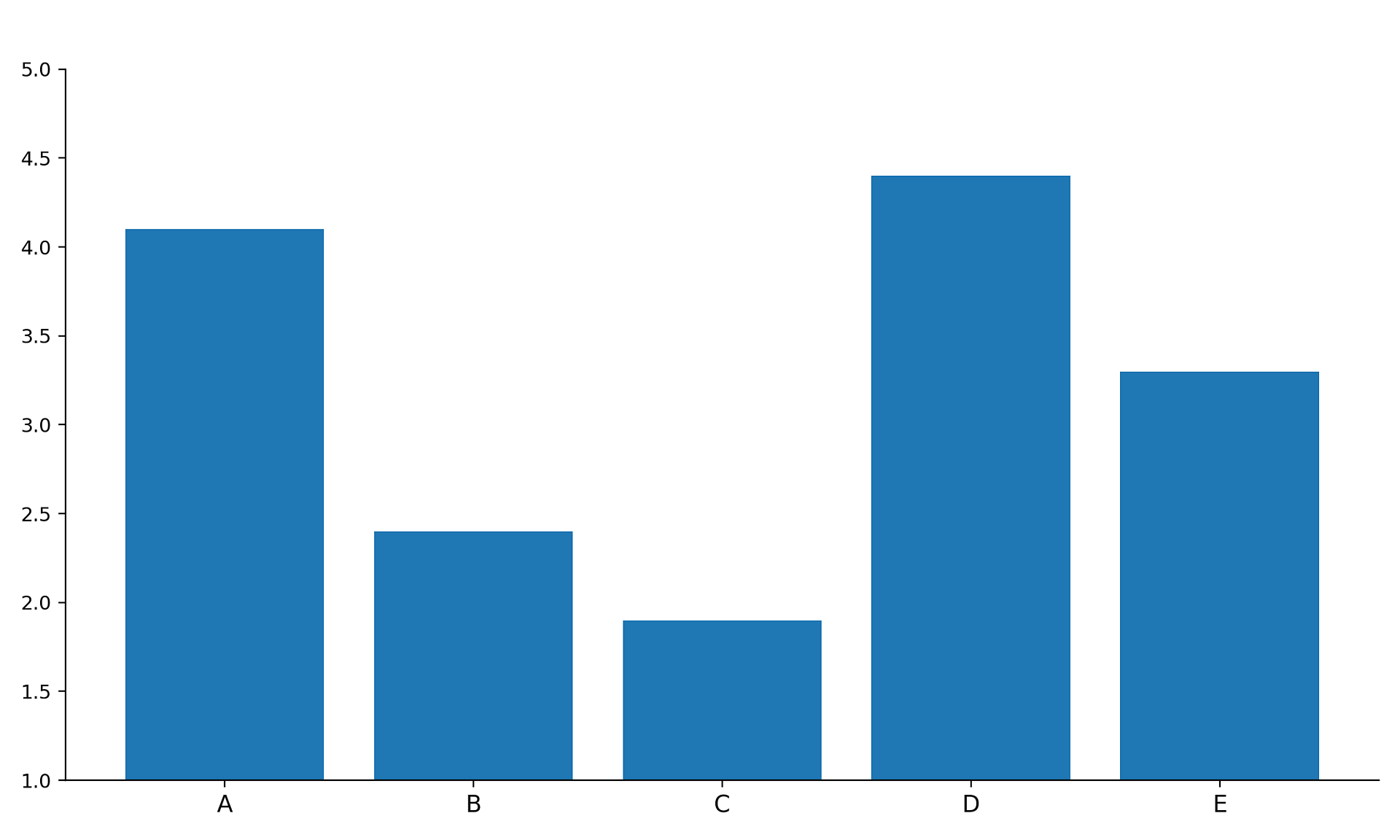
Assessment of subjective cognitive load (1–5)
Assessment of cognitive load after the first session. Average scores from 1-5 (N=4180)
- A - How mentally demanding this puzzle was
- B - How much mental effort you put into solving it
- C - How much time pressure / rush you felt
- D - How satisfied you are with how you performed
- E - How much irritation this task caused
| Question | Average |
|---|---|
| How mentally demanding was this puzzle? | 4.1 |
| How much mental effort did you put into solving it? | 2.4 |
| How much time pressure / rush did you feel? | 1.9 |
| How satisfied are you with how you performed? | 4.4 |
| How much irritation did this task cause? | 3.3 |
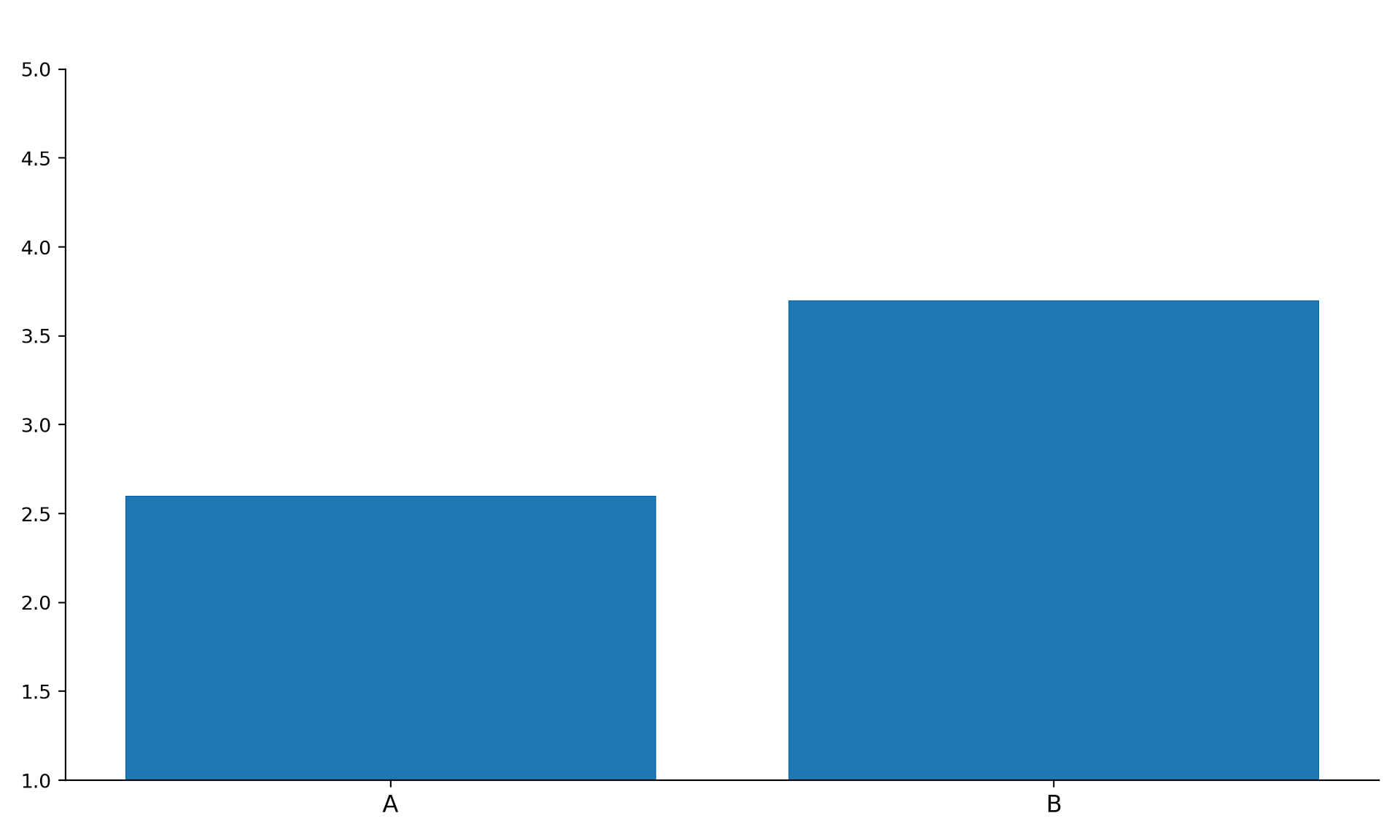
Stress and calmness (1–5)
Assessment of stress level after the first session. Average scores from 1-5 (N=4180)
- A - Felt stress / tension during the game
- B - Felt calm
| Question | Average |
|---|---|
| Felt stress / tension during solving | 2.6 |
| After solving, I feel calmer than before | 3.7 |
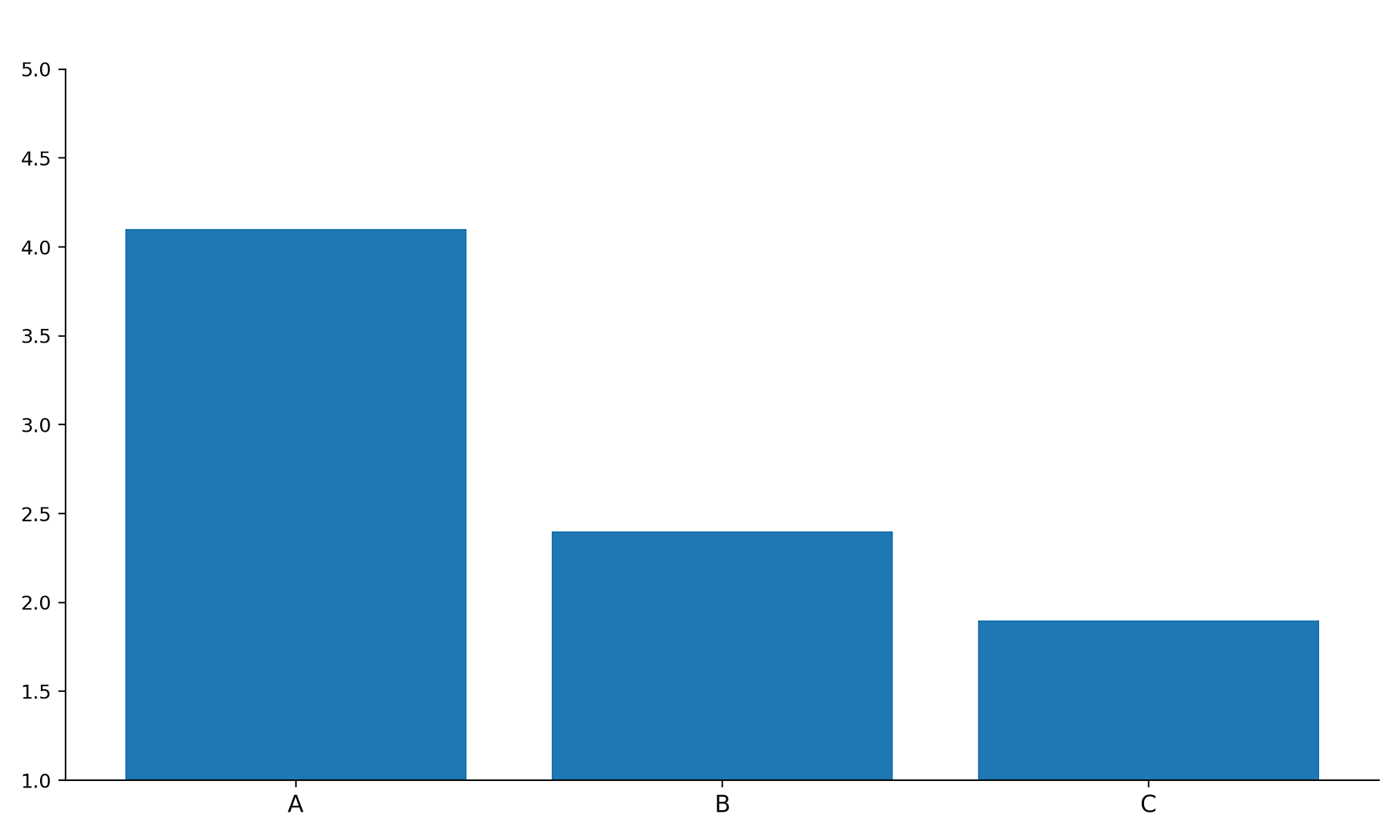
Engagement and focus of attention (1–5)
Assessment of focus and engagement. Average scores from 1-5 (N=4180)
- A - fully immersed
- B - often distracted
- C - was bored
| Question | Average |
|---|---|
| Fully immersed | 4.1 |
| Often distracted | 2.4 |
| Was bored | 1.9 |
Block 3. More than 10 game sessions
Self-assessment of cognitive changes (-3…+3)
(average values; 0 = “no change”)
Changes after 10 sessions, average values (scale from -3 to +3) N=1180
- A - concentration
- B - error recognition
- C - working memory
- D - cognitive flexibility
- E - planning
- F - speed of operations
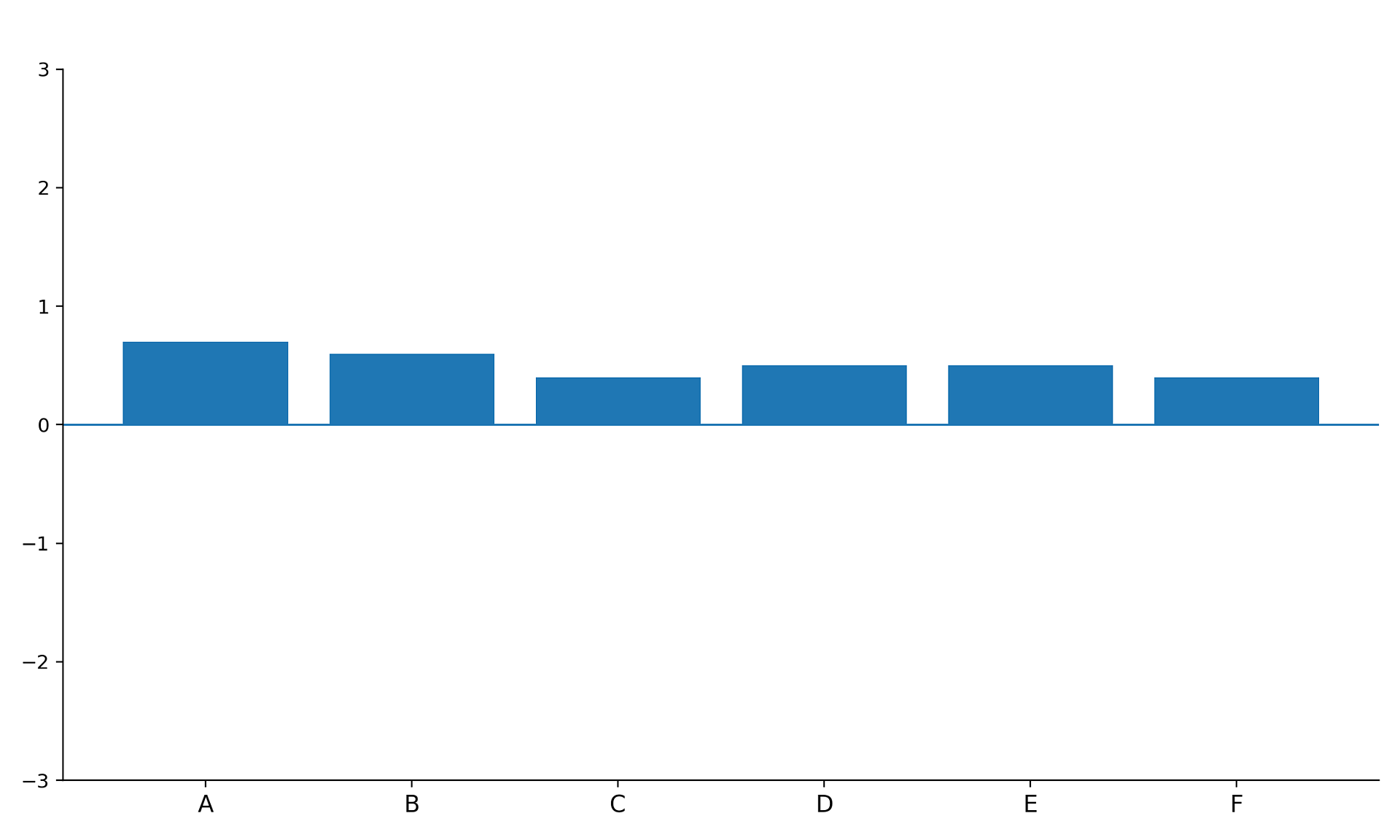
| Research area | Average |
|---|---|
| Concentration | +0,7 |
| Speed of error recognition | +0,6 |
| Working memory | +0,4 |
| Cognitive flexibility | +0,5 |
| Planning | +0,5 |
| Speed of “mental operations” | +0,4 |
Distribution for the “Concentration” area (average: +0,7)
- improved (+1…+3): 52%
- no change (0): 41%
- worsened (-1…-3): 7%
Distribution for the “Speed of error recognition” area (average: +0,6)
- improved (+1…+3): 50%
- no change (0): 43%
- worsened (-1…-3): 7%
Distribution for the “Cognitive flexibility (switching between tasks)” area (average: +0,5):
- improved (+1…+3): 48%
- no change (0): 45%
- worsened (-1…-3): 7%
Distribution for the “Planning” area (average: +0,5):
- improved (+1…+3): 47%
- no change (0): 46%
- worsened (-1…-3): 7%
Distribution for the “Working memory” area (average: +0,4):
- improved (+1…+3): 45%
- no change (0): 48%
- worsened (-1…-3): 7%
Distribution for the “Speed of mental operations” area (average: +0,4):
- improved (+1…+3): 44%
- no change (0): 49%
- worsened (-1…-3): 7%
Key survey results
Concentration and focus of attention
We live in a world overloaded with information, and this has become possible only recently because of digitalization and the speed of information transfer, which has become higher than ever before. Information noise and short-form content negatively affect focus; it has become difficult for us to perform the same things in a disciplined way, because the brain starts to get bored and demands a quick dopamine spike.
According to our survey results:
- 52% said that after playing Sudoku, their concentration improved
- 48% noted that switching between tasks became better
Following this logic, solving Sudoku on Sudoku-Guru.com can be used as a tool for focusing attention before work or important tasks.
This point of view is supported by studies: the frequency of engaging with number puzzles was associated with better scores on attention and reasoning tests.
Logic and planning
Just imagine: you are alive right now because a million years ago one person made the right decisions and did not die. Millions of years ago, someone did not go into a dangerous place, someone ran away in time, and someone chose the right life partner. Before you, there was an incredibly long unbroken line of your ancestors, and each of them had to live long enough to leave offspring. One mistake — and you would not have been able to read this text.
This became possible in part thanks to the rational part of your brain, where decision-making involves not only animal instincts but also logic. Logic helps weigh pros and cons, estimate consequences, and choose a more reasonable option.
- 44% of players noted that the speed of mental operations increased;
- 47% noted positive changes in planning.
From a scientific point of view, Sudoku really does require planning and control of game strategy (especially difficult and guru levels). This is discussed in scientific papers, where Sudoku is used as a task with high cognitive engagement related to planning.
Memory. The most controversial point
We found that studies on Sudoku and memory are heterogeneous in terms of results. For example, in a randomized clinical study of hemodialysis patients, Sudoku clearly reduced anxiety, while the results for memory were less pronounced and some metrics were statistically borderline.
At the same time, some of our users still noted subjective changes in everyday life:
- 45% noted that memory in daily activities improved;
- 48% noticed no improvements.
This only suggests that subjective sensations do not always correspond to measurable gains. Perhaps this effect was achieved through reduced anxiety and stress levels.
Emotional effect and reduced anxiety
“It is calm concentration, like meditation but with numbers” — this is roughly the opinion people form about the gameplay process.
In clinical studies, Sudoku is most often studied as an activity that reduces anxiety. It is important to note here that we are talking specifically about anxiety, not depressive conditions, where specialist help is necessary. Sudoku is definitely not an antidepressant, but it can help you relax after a hard day.
In our survey:
- 3.7 (out of 5) — the average score from users who use Sudoku as an anti-stress activity or a break to distract themselves
At the level of large observational studies, the connection between cognitively stimulating activities and more favorable cognitive trajectories in older age is generally confirmed.
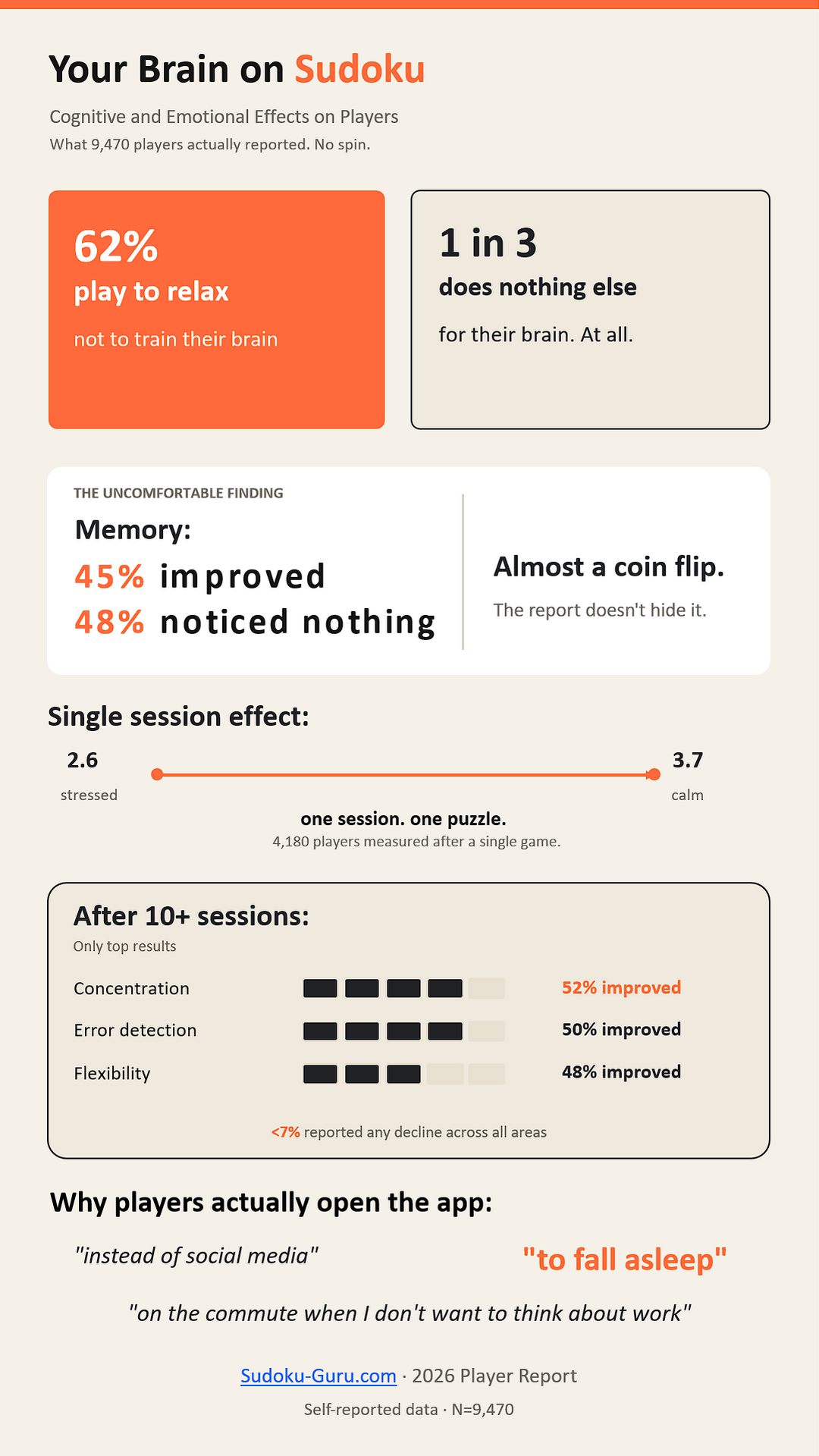
Infographic with research results
Conclusion
Based on our work, we prepared instructions on how to play Sudoku with maximum benefit for the brain:
- Daily playing time in the range of 10–20 minutes. Regularity is more important here than one long game session
- Gradual increase in difficulty levels. Our brain adapts quite quickly to one level of load.
- Alternate play modes. Spend half the time playing thoughtfully and deliberately, and the other half trying to play for speed. This way you activate different parts of your brain and cover a greater cognitive load.
- Try replacing vertical-content scrolling with a game of Sudoku-Guru. From the standpoint of science and benefit for your brain, this kind of pastime is much more useful.
Your action plan for today:
- Close social media.
- Open Sudoku-Guru.
- Set a timer for 15 minutes.
- Start with a difficulty level that makes you think a little, but does not leave you stuck.
Practice regularly, vary the pace, and keep your brain in shape!
Thank you for participating in the survey, your Sudoku Guru :)