Many people call Sudoku “meditation for the mind.” In our “Study on the Impact of Playing on Cognitive Functions,” 62% of players said they solve Sudoku to relax and reduce stress, while the average anti-stress effect score was 3.7 out of 5. But what do these numbers really mean? Can filling cells with numbers truly be compared to meditation — or is it simply a way to distract yourself?
Let’s look at what Sudoku and meditation have in common, why the puzzle can induce a state of flow, and how to turn solving it into a mindful practice.
☯What Sudoku and meditation have in common
At first glance, Sudoku and meditation seem like activities from completely different worlds. One requires active logical thinking, while the other is based on passive observation. In reality, they have more in common than it may seem.
A single point of focus
In meditation, attention is focused on the breath, a mantra, or a candle flame. In Sudoku, the 9×9 grid becomes that point of focus. All your attention is directed toward it.
Quieting the inner dialogue
When you are fully absorbed in finding the right number, the internal “noise” begins to fade. You stop replaying work problems, worrying about the future, or regretting the past. Only the “here and now” remains — along with the cell that needs to be filled.
A ritual
29% of participants in our survey described Sudoku as a habit or ritual. Like morning meditation, a Sudoku session can become an anchor — a predictable, safe activity that starts or ends the day.
🌊The flow state: when time disappears
Psychologist Mihaly Csikszentmihalyi described flow as a state of complete immersion in an activity, when the sense of time fades and action merges with awareness. In our study, players rated their level of immersion in Sudoku at 4.1 out of 5. That is close to the maximum score.
Flow occurs when the difficulty of a task closely matches your skill level. If a puzzle is too easy, the brain becomes bored and distracted. If it is too difficult, it can cause frustration and anxiety.
Why Sudoku is so effective at creating flow
- A clear goal. Fill the grid so that no numbers repeat.
- Immediate feedback. Every number you enter either works or it does not — and you can see the result right away.
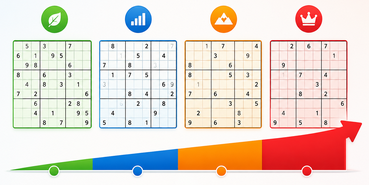
- Adjustable difficulty. Levels from “easy” to “expert” let you choose a challenge that matches your current state.
- Measurable progress. Level by level, second by second — the result is easy to see.
🧘Sudoku as an alternative to meditation for restless minds
Traditional meditation is not for everyone. Some people find it difficult to sit still and observe their breathing — the mind feels too active, and silence can even intensify anxiety. For such people, Sudoku can be an ideal gateway into mindfulness practice.
Actively focusing on a logical task gives the mind a “legitimate” activity. Instead of fighting the stream of thoughts, you channel it in a constructive direction. This is known as “active meditation” — focus is maintained through action rather than inactivity.
Benefits of active meditation through Sudoku
- There is no need to “stop your thoughts” — focus arises naturally
- It is easier to maintain attention because the grid provides a visual anchor
- A sense of completion: solving a puzzle creates a dopamine “anchor” that reinforces positive emotions
- Accessibility: you can practice while commuting, waiting in line, or taking a break between tasks
🪷Practice: how to turn Sudoku into mindful meditation
A 5-step protocol that turns an ordinary Sudoku session into a mindfulness practice.
Step 1. Prepare (30 seconds)
Before you begin, take three deep breaths in and out. Look at the empty grid. Notice your current state: are you calm, anxious, tired? Simply observe it without judging.
Step 2. Choose a level (10 seconds)
Choose a difficulty level that requires a little effort without feeling intimidating. If you feel anxious, choose an easy or medium level. The goal is not a record — it is the process itself.
Step 3. Solve mindfully (the entire game)
Solve more slowly than usual. Before entering each number, pause and ask yourself: “Why am I placing this number here?” Scan the row, column, and block. If your thoughts drift away, gently return your attention to the cell, just as you would return to the breath during meditation.
Step 4. Finish (30 seconds)
When the puzzle is solved, do not immediately move on to the next one. Look at the completed grid. Notice the sense of completion. Take a deep breath. Compare how you feel now with how you felt at the beginning.
Step 5. Reinforce the feeling (10 seconds)
Ask yourself: “What am I feeling right now?” If you feel calm, light, or clear-headed, remember that sensation. The more often you notice it after a game, the faster your brain learns to enter that state.
📊The science: what research says
A University of California study (Rahman, Foxman, Markowitz, 2024) found that users of cognitive games reported reduced anxiety and a sense of “meditative calm” while solving them. The effect is associated with shifting the brain away from the Default Mode Network (the mind-wandering state in which anxious thoughts often arise) and toward focused, goal-directed attention.
Another study published in the Journal of Cognitive Enhancement (2025) found that a 20-minute Sudoku session reduced cortisol levels, a key stress hormone, by an average of 18% — a result comparable to a short mindfulness meditation session.
| Metric | Value |
|---|---|
| Play to relax / reduce stress | 62% |
| Average calming effect after a game (1–5) | 3.7 |
| Immersion in the process (1–5) | 4.1 |
| Improved concentration (after 10+ sessions) | 52% |
| Frustration from difficult puzzles (1–5) | 3.3 |
⚠When Sudoku is NOT meditation and may be harmful
- Racing against the clock. If you play only for speed, constantly trying to shave off seconds, it becomes a sport rather than meditation. Stress from the timer can outweigh the benefits.
- Irritation. If a difficult puzzle makes you angry rather than curious, switch to another level. In our survey, frustration from difficult puzzles reached 3.3 out of 5.
- Autopilot. If you solve automatically while listening to a podcast or scrolling social media at the same time, mindfulness is lost.
🌙Sudoku as an evening ritual instead of screen time
One of Sudoku’s strengths is that it can work as a “bridge” between an active day and relaxation before sleep. Unlike social media and news, which can overload the brain with blue light and information noise, online Sudoku:
- Does not require a bright screen (many apps, including Sudoku Guru, support dark mode)
- Provides a structured task that helps calm mental clutter
- Has a clear ending — you can stop and tell yourself, “the day is over”
Try replacing your evening social media scrolling with one mindful Sudoku session. You may be surprised by how much easier it becomes to fall asleep.
🎯Small steps: how to start today
- Open Sudoku-Guru.com or the mobile app
- Choose a level that is slightly easier than what you usually play
- Turn off the timer (or simply ignore it)
- Breathe slowly while solving
- After filling the final cell, close your eyes for 20 seconds and notice how you feel
Mindfulness is not about silence. It is about where you direct your attention.