Why errors occur in sudoku
Sudoku seems like a simple puzzle: you need to place digits from 1 to 9 so that they do not repeat in rows, columns, and 3×3 blocks. However, even after learning the rules, beginners often make mistakes that lead the solution into a dead end.
The main reason for failure is trying to act too quickly. Let's examine ten typical mistakes and figure out how to solve sudoku more carefully and efficiently.
1 Guessing a digit instead of logical deduction
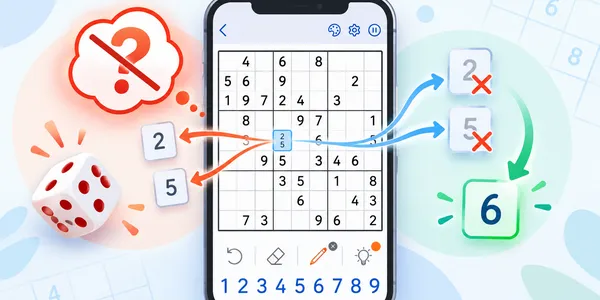
The most common beginner mistake is placing a digit because it seems right. Sometimes the guess turns out to be correct, but if the choice is wrong, the contradiction may only be discovered several moves later.
The player continues filling the grid, and then notices a repeating digit or a cell where no option can be placed anymore. Then they have to go back and find the moment when the mistake was made.
2 Ignoring notes
On easy levels, many cells can indeed be filled without additional marks. Because of this, a beginner gets used to keeping possible options in memory and continues to do the same on medium or hard levels.
When there are many empty cells, it's impossible to remember all the options. The player starts re-checking the same areas, loses time, and makes more mistakes.
3 Checking only rows or only columns
Some beginners get used to moving across the grid in only one direction — for example, checking rows from top to bottom. At the same time, they pay almost no attention to columns and 3×3 blocks.
A cell may have several possible values when checking a row, but after analyzing the column and block, only one valid digit remains.
Check the cell in three directions
- which digits are already in the row;
- which digits are in the column;
- which values are used in the 3×3 block.
Only checking all three areas together allows you to make a reliable conclusion.
4 Scanning the grid without a system
Chaotic movement across the grid creates a feeling of active work, but often leads to re-checking the same cells. The player may scan the top part of the sudoku several times and barely analyze the bottom blocks.
It is especially inconvenient to search for all digits in all cells at once. Attention quickly scatters, and obvious options go unnoticed.
5 Not updating notes after each move
Even correctly made notes become outdated over time. After placing a new digit, some candidates in the same row, column, and block become impossible.
If you don't remove these values, extra options remain in the cells. The player may miss a single candidate or later choose a digit that already contradicts the filled part of the grid.
6 Spending too long analyzing one cell
If a cell resists solving, a beginner may keep examining it for several minutes, checking the same options over and over. Usually this doesn't help: there simply isn't enough information yet to make the right conclusion.
New opportunities appear after filling other parts of the grid. A cell that seemed difficult may later be solved in a few seconds.
7 Rushing and not checking the move you made
The desire to solve sudoku faster often reduces attentiveness. The player finds a suitable digit, immediately places it and moves on, without checking all related areas.
This leads to simple mistakes: a digit repeat in a column, an unnoticed value in a neighboring part of a block, or accidentally picking the wrong cell.
Before every final move, check:
- whether this digit is already in the row;
- whether this digit is already in the column;
- whether this digit is already in the 3×3 block.
8 Not noticing single candidates
Sometimes after eliminating unsuitable values, only one possible digit remains in a cell. A beginner may not notice this, especially if there are many notes or they haven't been updated in a while.
There is also another situation: in a row, column, or block, a certain digit can only be placed in one cell, even if that cell has several candidates written in it.
Single candidate
Only one digit fits in a specific cell.
Only place
The required digit can only be placed in one cell of the selected row, column, or block.
9 Moving to a hard level too early
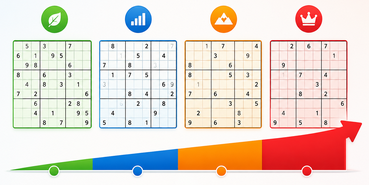
After several successfully solved easy puzzles, you want to immediately try the expert level. But the difficulty of sudoku is determined not only by the number of empty cells. Solving may require more advanced logical techniques.
If basic methods are not yet automatic, a difficult grid seems impossible. The player starts guessing, constantly using hints, or decides that sudoku is not for them.
10 Continuing after discovering a contradiction
Sometimes a player notices a repeated digit or realizes that no valid options remain for one of the cells, but still keeps filling the grid. They hope the problem will resolve itself after the next moves.
In a correctly constructed classic sudoku, a logical contradiction usually means that an incorrect digit was placed earlier or a candidate was wrongly removed.
How to solve sudoku without mistakes: a short algorithm
- Find rows, columns, and blocks with the largest number of filled cells.
- Determine which digits are missing from them.
- Eliminate options that already appear in intersecting areas.
- Write a digit only when the result is unambiguous.
- Use notes for uncertain cells.
- Update candidates after each move.
- If the solution stalls, switch areas or start scanning the grid by individual digits.
- Do not use random selection just to keep the game going.
The key is not speed, but consistency
Most mistakes of beginner sudoku players are related not to not knowing the rules, but to haste and lack of a system. Don't try to fill as many cells as possible in a short time. Each move should provide new reliable information about the grid.
Use notes, check rows, columns, and blocks, regularly update candidates, and don't be afraid to temporarily skip difficult cells. Gradually, you will start noticing logical connections faster, use hints less often, and more confidently move on to hard levels.
The best way to learn to solve sudoku without mistakes is to practice regularly. Start with easy puzzles, apply the described recommendations, and gradually move on to more challenging tasks.